
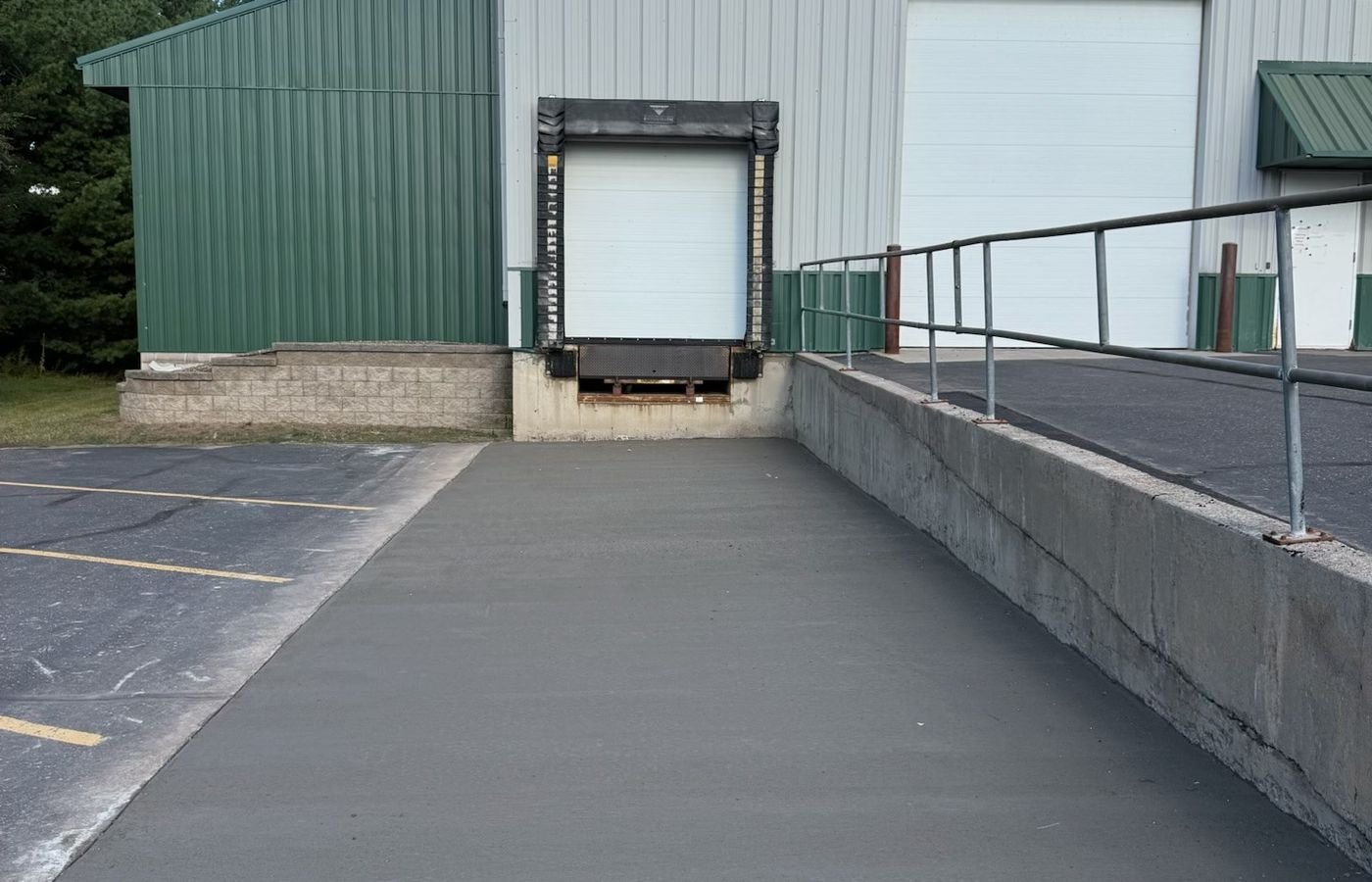
Landing gear finds the weak spot in a truck court sooner than any engineer's calculation does. A trailer parked for a week with its front legs on a few square inches of pavement puts a point load on the surface that asphalt cannot be expected to carry through an Oklahoma summer. That is why most serious dock areas use reinforced concrete, and why the details around joints, dowels and drainage matter more than the headline thickness.
We build truck courts, dock aprons, trailer storage pads and the approaches that connect them to public roads. The scope usually starts where the building slab ends, and the design has to deal with the transition between the interior floor, the dock leveler pit and the exterior apron, an area that suffers from constant braking, turning and impact.
Owners of distribution and industrial buildings often tell us that the truck court was the last item they thought about and the first one that caused problems. We prefer to start the conversation about it before the building is even laid out.
Oklahoma's freight network gives owners many reasons to think hard about trailers. The state commerce department counts three interstates, I-35, I-40 and I-44, that meet in the state, over 12,000 miles of highway and over 2,600 miles of Class I rail. Port Muskogee describes 5.5 miles of railroad with daily service for Class 1 interchange and cargo transfer, and more than 312,300 tons of rail cargo moved annually.
Distribution projects reflect that network. A regional pharmaceutical distribution facility of 330,000 square feet was announced for the North Moore Industrial Park in June 2026 with $179 million in capital investment and more than 200 direct jobs. In Chickasha, the Greater Oklahoma City Chamber describes a 240-acre industrial park on Interstate 44 at the intersection of U.S. 81 and U.S. 62, with rail service four times daily. Every one of these sites turns trailer flow into the main design driver, and we build the truck courts with that flow in mind.
The core pieces are the dock apron, directly in front of the doors, the maneuvering lane where tractors turn and back, the trailer parking stalls and the drive aisles that connect to the street. The dock apron is almost always concrete, often thicker than the drive lanes, with dowelled joints and a slope that sheds water away from the building. Parking stalls get landing gear pads or full-depth concrete in the stall.
We also build the supporting items: dock bumpers, wheel guides, bollards, trailer stops, light pole bases, truck scale foundations when called for, and the curbs that direct water. Striping and signage follow, because a dock court that is not marked clearly causes accidents. Each of these details is small on the plans, and each one tends to be expensive to change after the concrete is poured.
Pavement design for a truck court is based on the number and weight of trucks, the subgrade strength and the lifespan the owner expects. The civil engineer or a pavement consultant usually sets thickness and reinforcement, and we build to those drawings. Where the owner is unsure, we can request a pavement design based on the geotechnical report and expected traffic.
Drainage and access approvals run in parallel. A new truck court adds impervious area, so stormwater review is almost always involved, and a new driveway onto a state highway may need a permit from the Oklahoma Department of Transportation. Tying these approvals together early avoids a surprise at the end. The trade partners for stormwater and drainage build the inlets and outlets at the same time as the pavement so the finished grades match.
We schedule, supervise and inspect the formwork, rebar placement, dowel installation, placement and finishing of dock aprons and slabs. A good apron is mostly about care at the joints: load transfer dowels set straight and at the right depth, expansion material in the right locations and saw cuts made in time. Each of those tasks is something we check on every pour.
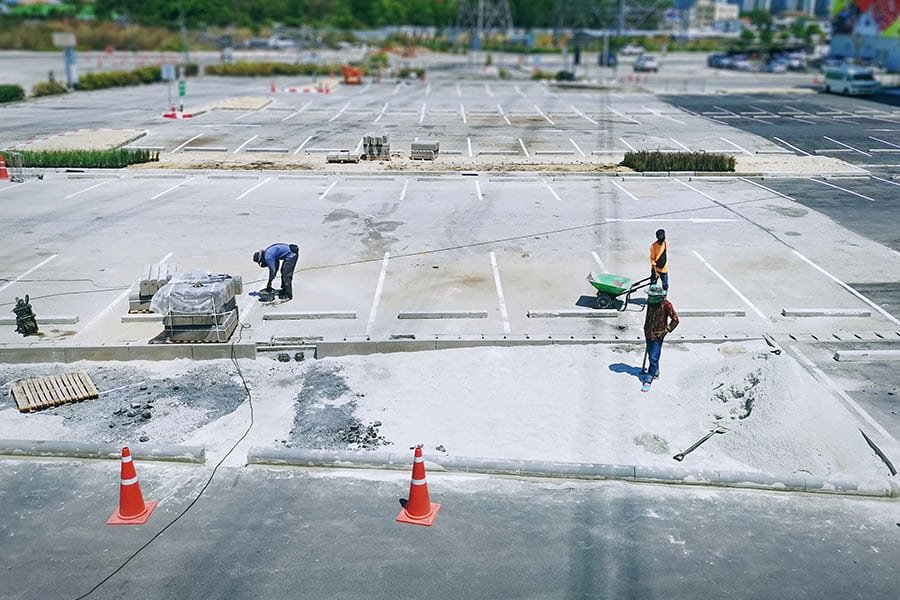
For large lots, we sequence the paving and grading trade partners so that subgrade preparation, base placement and paving happen in one continuous sequence. That prevents a lag between the finished base and the paving that lets rain wash out the prepared surface. We also schedule curing and joint sealing so the pavement is ready for trucks when the building is.
We build in industrial parks, port areas, small-town airparks and on isolated rural sites. Near Moore and along the I-35 corridor, the work is shaped by metro review and tight lots. At Chickasha and other railroad towns, the lots are larger and the rail spur adds its own layout limits. At MidAmerica Industrial Park near Pryor, the scale of the park and the number of trucking carriers shape expectations.
Distance matters as well. A truck court in the western part of the state may be a long haul from the nearest concrete plant, and we plan pours around delivery time, which affects the mix and the schedule. We work with ready-mix suppliers across Oklahoma and know which plants can handle a big placement and which cannot.
A truck court is only one part of a freight facility. It is joined to the distribution center it serves, to the employee and visitor parking that sits beside it and to the public road that brings the trucks in. We coordinate all three so the grading, the drainage and the pavement edges meet without conflict.
For owners who plan a truck terminal or cross-dock, where doors line both sides of a narrow building, the court design is a larger share of the project, and we treat it as such. And for property management firms that must maintain pavement for a tenant, we leave a joint sealing and repair guide with the closeout documents.
Share your trailer counts, building layout and site plan. We will return a pavement scope, a joint plan and a schedule that matches your building turnover.
FAQ
Send the property, the building type and the schedule. We review the scope, the approvals and the trade packages and explain how the project would be sequenced.