
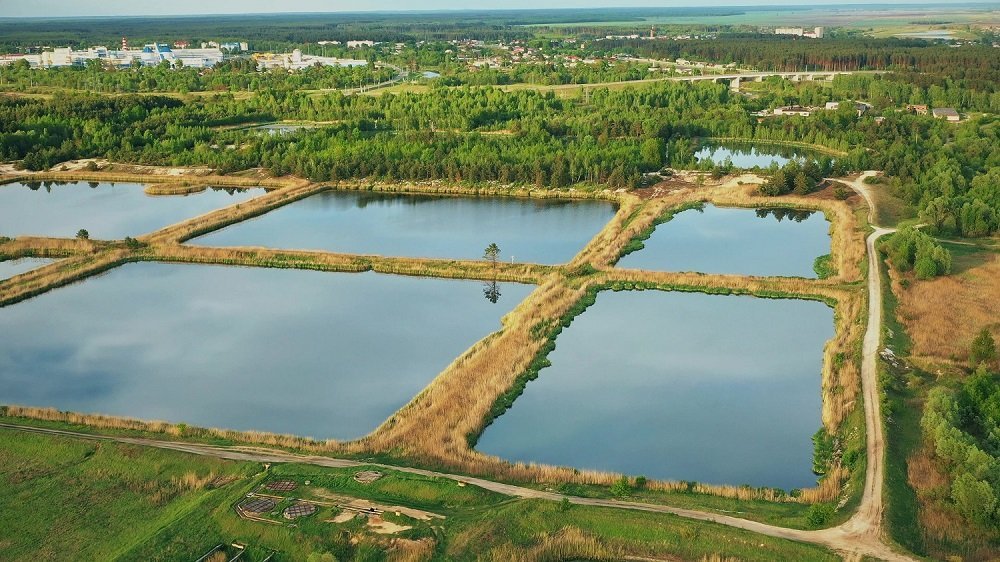
Water decides more Oklahoma site layouts than zoning does. A detention pond takes the corner a developer wanted for a pad, a channel easement narrows a frontage, and a storm sewer ties the whole parking field to an outfall that someone else owns. We build the drainage systems that sit behind those decisions, and we try to get them right the first time because a failed pond or a backed-up inlet shows up in the owner's first hard rain.
Our scope covers storm sewer pipe and structures, curb and area inlets, detention and retention basins, outlet structures, swales, channel lining and the grading that sends water where the engineer drew it. We work from civil drawings, but we also read the ground. When a drawn outfall elevation does not match what the survey finds, we raise it in preconstruction instead of after the pipe is in the trench.
Oklahoma owners deal with a wide range of conditions, from the Panhandle to the river bottoms in the east. A system that works for a flat commercial lot may fail on a sloped institutional campus, so we treat each drainage design as a local problem with a local history.
The state's flood record is a working reference for how conservatively to build. The National Weather Service reports that the Memorial Day flood of May 26 to 27, 1984 killed 14 people and injured 288 in Tulsa, with $180 million in damages, of which Mingo Creek alone accounted for $125 million. That single creek explains why Tulsa treats drainage design as serious infrastructure and why we pay attention to downstream conditions, not just the property line.
Smaller rivers carry similar lessons. Wikipedia reports that the Caney River flooded in October 1986, splitting Bartlesville in half for several days, and flooded again in June 2007, cresting five feet below the 1986 level. The same source says Jenks has a levee built by the Corps of Engineers in 1948, and that a 1986 release from Keystone Dam led to a mandatory evacuation order there. We treat those reports as context rather than design criteria, but they shape how we talk to owners in Bartlesville and Jenks about freeboard and overflow routes.
A drainage plan is usually reviewed twice, once by the city or county engineering office and again by whatever agency controls the receiving stream or the road right-of-way. We ask early which office will review the plan, what storm event the detention must handle and whether the outfall needs an easement from a neighbor. Those three answers set the schedule more than any construction task does.
The Oklahoma Water Resources Board promotes the state's comprehensive water plan, publishes a pending water use permits dashboard and cites a $24 billion water infrastructure need. For most commercial owners drainage review starts locally, but we help sort out which agencies actually apply. We keep the inspection requests, as-built surveys and pond certification records organized so that the final inspection does not stall on paperwork the engineer and city already agreed to.
The pipe work is the most visible part and the least forgiving. We hold line and grade by laser, bed the pipe to the engineer's detail, set structures to the right invert and backfill in lifts that the inspector can witness. A storm line that settles after paving costs far more to fix than it did to install, so we test and document each run before it is buried under stone and asphalt.
Detention basins have their own problems. Side slopes, outlet structures, trash racks and emergency spillways all need to match the drawings, and the bottom needs to drain the way the design says it will. We stabilize the basin with seed, mat or sod before it sees heavy flows and we leave the owner a maintenance note describing what to inspect and when. A basin that fills with sediment in year two is often a basin that was never stabilized properly in year one.
We build the permanent drainage first wherever the plan allows. Installing the storm sewer and outlet early lets the contractor use the pond as a sediment trap during construction and keeps rain off the building pad. It also gives the owner a way to see the system work before the paving crew arrives, which is the cheapest moment to catch a low spot.
The approach ties directly to our mass grading work, because the pad elevation, the subgrade slope and the storm profile are all part of one design. On public work, the same discipline matters for government and public-sector owners, whose inspectors expect to see the as-built drainage match the bid set. We do not leave a gap between the drainage contract and the paving contract for something to fall into.
Drainage is rarely a standalone job. It shapes parking lot construction, because the inlets and slopes define the pavement layout, and it shapes foundations, because groundwater and surface flow around a slab need to be kept apart. We coordinate these trades in one schedule so that no crew has to cut into a finished system to reach a lower one.
Owners often ask whether a big site is better built in a single sweep or in phases. Our answer depends on the drainage. If the pond and outfall can be built first for the whole tract, phasing the buildings behind it is easy. If not, each phase needs its own temporary drainage plan. The trade partners for concrete foundation crews and drainage meet on that plan before either starts.
Send us the civil set and your site location. We will review the outfall, the detention volume and the sequencing, then return a price and a schedule that works around Oklahoma rain.
FAQ
Send the property, the building type and the schedule. We review the scope, the approvals and the trade packages and explain how the project would be sequenced.