
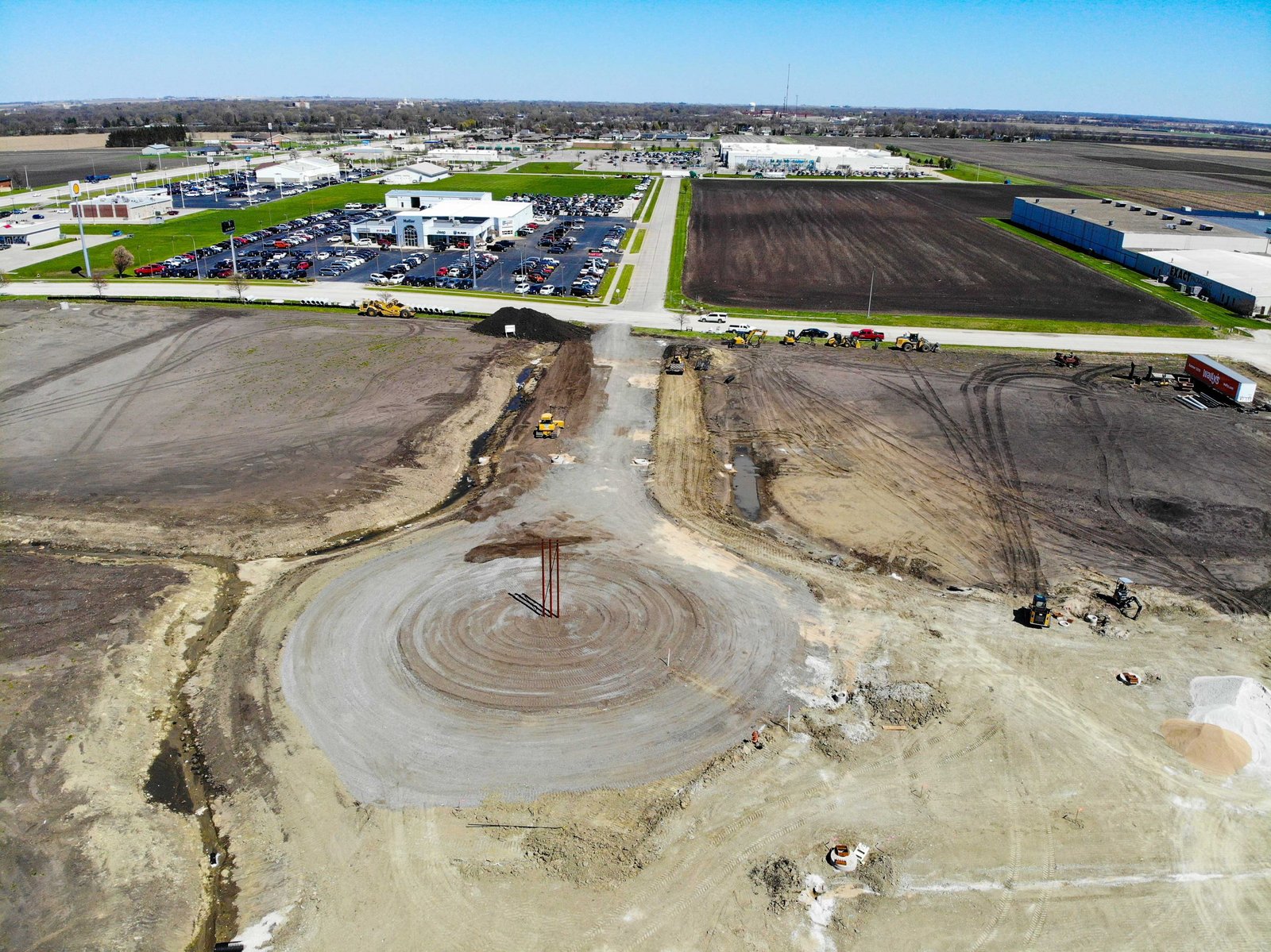
Cut and fill balance is the first number we ask for on a grading job, because it decides whether dirt leaves the site on trucks or stays on it as a finished pad. On a flat tract the answer can be simple. On a rolling Oklahoma parcel with a creek along one edge, it takes survey, boring logs and a haul plan before anyone can promise a price.
We handle mass grading for owners who need a building pad, a truck court or a parking field ready by a date, not just dirt moved around. That means clearing, topsoil stripping and stockpiling, rough cut and fill, subgrade proofing and handing the pad over in a state the foundation crew can start on without waiting for a dry week.
The work looks different in different parts of the state. A tribal government campus in the east, a rail-served industrial lot in the south and a hangar apron near a military base each bring their own drainage, access and inspection demands. We treat each as its own site and price the earthwork honestly instead of carrying one rate across all of them.
Grading is where close supervision pays for itself. When our superintendent coordinates the earthwork trade partner running the scrapers, dozers, compaction equipment and water trucks, the person who reads the survey stakes is in daily contact with the person who adjusts the cut when rock or wet clay shows up. There is little handoff delay between a subcontractor finding a problem and the superintendent hearing about it.
We pair the machine work with testing from the start. Moisture and density checks at each lift, proof rolling of the exposed subgrade and a written record of undercut areas give the engineer of record what is needed to accept the pad. Owners who plan to sell or finance a warehouse later find that record valuable, because the pad documentation stays with the property long after the grading crew has left.
The sites in play right now are not small. The Cherokee Industrial Park on the north side of Tulsa is described by the state commerce department as more than 1,300 acres near U.S. 75, U.S. 169 and the Tulsa Port of Catoosa. Near the Arkansas River in Muskogee, the port acquired a 125.49-acre site that includes 81 bordering acres of riverfront property outside the regulatory floodplain, with direct access to Class I rail.
Further south, a railroad expansion at the Ardmore industrial airpark was reported under construction in March 2026, while Grumman Road is rebuilt to link the airpark to Highway 53. Each of these is a rail-served or road-served industrial setting where the pad has to be flat enough for a distribution center and still shed water. We read those conditions before we bid. Our Muskogee and Ardmore pages cover how we approach those two markets in more detail.
A floodplain boundary is the line that most often changes a grading plan. Fill placed inside a mapped floodplain can trigger local review and compensating cut elsewhere, so we ask for the current flood map and the local floodplain administrator before the earthwork quantity is final. A site that sits just outside that line, like the riverfront acreage at the Muskogee port, is worth more to a developer exactly because the fill question goes away.
We also look at what is underneath. Oklahoma sites vary from sandstone shelf to soft alluvium, and we do not assume one kind of soil statewide. Our practice is to request the geotechnical report before pricing, compare the boring locations to the building footprint and flag any area where the pad will cross a boring-to-boring change. Where owners have not yet commissioned borings, we help scope them so the earthwork allowance in the budget is a real number.
Grading schedules in Oklahoma are written around rain. The National Weather Service tornado table for the state shows May as the peak month, and the same spring pattern brings the heavy rain that stops earthwork for days. We plan the cut and fill so that the largest exposed areas are worked in the drier stretches and the pad is sealed with a rolled, graded surface before a forecast storm arrives.
Haul routes matter just as much. On an urban infill lot the route is set by turnpike and arterial access and by how many loads a neighbor will tolerate. On a county road, it is set by the weight limits and the dust. We walk the route, document road condition before we start and agree on a wash-down and cleanup routine that keeps the owner out of trouble with the county. A pad that finishes on time but wrecks a county road has not been a good job.
The largest line in a grading budget is usually not the dozer time. It is haul distance, imported or exported fill, undercut and replacement of unsuitable soil, and the cost of keeping a wet site workable. An early topographic survey and a geotechnical report move those lines from guesses to quantities, and the difference shows up in the contingency the owner has to hold.
We give owners a cut and fill summary, a list of the allowances that remain uncertain and an alternate if one design choice, such as lowering the finished floor by a foot or two, could balance the site without hauling dirt. That conversation belongs in preconstruction, which is why we tie grading to the same estimate that covers site development and utilities. Developers who budget the dirt work separately from the building often find the gap at the worst time, which is why commercial real estate developers bring us in before closing.
A disturbed site in Oklahoma needs a stormwater pollution prevention plan, inlet protection, silt fencing and stabilized construction entrances, and the inspector will want to see them in place and maintained after every storm. We build those measures into the grading sequence rather than bolting them on afterward, because a sediment problem that reaches a neighboring property becomes a permit problem for the owner.
We also manage the operating hazards that come with earthmoving: spotters around haul trucks, marked underground utilities before any cut, and daily equipment checks. Where grading sits next to a rail line, a road under traffic or an operating plant, we agree the exclusion zones with the owner in writing before the first shift. Our related stormwater and drainage work follows the same rule that the permanent system is installed as the grade comes up, not after.
Send us the survey, any boring logs and your target start date. We will return a cut and fill summary, a list of allowances and a schedule built around Oklahoma weather, whether the site is in a metro area or at the end of a county road.
FAQ
Send the property, the building type and the schedule. We review the scope, the approvals and the trade packages and explain how the project would be sequenced.