
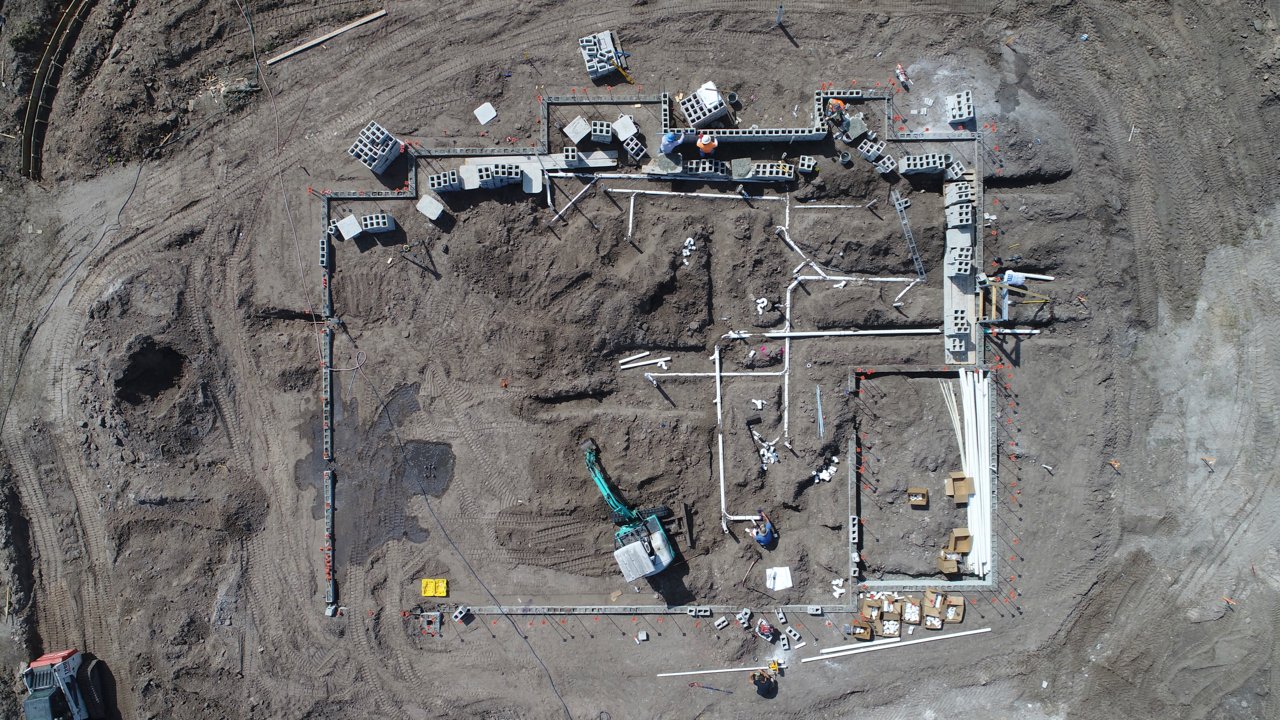
One creek accounted for $125 million of the $180 million in damage from the Memorial Day flood of 1984 in Tulsa, according to the National Weather Service. Mingo Creek is a small waterway on a map, and it still caused most of the loss. That is the lesson owners should carry into any site: the quiet, ordinary-looking drainage path is the one that decides how the building sits, how high the pad goes and what the detention pond has to hold.
Site development and utilities are the work that turns a parcel into a buildable pad: clearing, grading, drainage, water, sewer, power, gas, communications and the roads and paving that connect them. We do this work as part of a building contract and as a stand-alone package for owners, developers and public agencies across Oklahoma. The conditions are very different from a Tulsa floodplain to a panhandle farm field, and this page explains how we handle them.
We like to walk a site before the owner closes. We look at the topography, where water enters and leaves, the soil, the vegetation, the existing utilities and the road frontage. We ask for the survey, the floodplain map and any geotechnical borings, and we compare them with what we see. A site that looks level may hold clay that swells, a high water table or buried lines nobody recorded.
Red clays are common in central Oklahoma and require care under slabs and pavements. Where a river or creek runs through the area, we check flood elevations and the local floodplain rules. In Tulsa County, the Oklahoma House reported in May 2024 that the Army Corps of Engineers placed the river levee system among the 5% of levees most at risk of failure, with $50 million in state funding for repairs, which reminds us that flood protection around the city is under review. Where a site depends on a levee, the owner should know it.
Site work involves several approvals. Cities and counties review grading and drainage plans, and projects that disturb an acre or more usually need stormwater pollution prevention measures and a state general permit for construction runoff. The Oklahoma Water Resources Board handles permits for water use, and it highlights a $24 billion water infrastructure need across the state, so owners should confirm water capacity in writing, not assume it.
Detention and drainage are the usual sticking points. A city engineer may require that a developed site release no more stormwater than it did before, which means a detention basin or underground storage. We design these with the civil engineer so they fit the site plan, and we place them where they can be maintained. Our stormwater and drainage page covers this in more detail, and our mass grading work shows how large pads are shaped.
We install water, sanitary sewer, storm sewer, gas and conduit for power and communications. That means trenching, bedding, pipe, manholes, thrust restraints, testing and backfill, all inspected by the city or the utility. We coordinate the connection dates with the utility, because a tap or a transformer delivered late can hold up a building.
Water supply can be a real constraint. In Guymon, a city that draws from the Ogallala Aquifer, a report in September 2025 said the city had leased rights to 640 acres of water for its Mesa Water Project through 2080, with first water expected in October 2026. Panhandle owners should ask about water early, and we describe the options in our work for Guymon and nearby towns. On the east side of the state, small towns may have aging lines that need replacing before a new customer can connect.
Earthwork, utilities and paving are the biggest lines. Earthwork depends on the cut and fill balance, haul distance and the weather. Utilities depend on length, depth and rock. Paving depends on the subgrade and the traffic. We give owners a site budget with each of those lines, and we call out unknowns such as rock, unsuitable soil and unmarked utilities.
Public funding can change the picture. Soldier Creek Industrial Park in Midwest City, a 40-acre site owned by the city's utilities authority, was developed beginning in 2012 with a $1 million federal Economic Development Administration grant and a $2 million city contribution. Grants like this pay for roads and utilities and come with reporting rules. We help owners track those requirements, and we often work with commercial real estate developers who combine private and public money.
Site work happens first, in the weather. Oklahoma has wet springs and dry, windy summers. We plan clearing and mass grading for drier months where we can, install erosion control before earthwork starts and keep haul roads and silt fence in repair. A heavy rain on bare soil can cost a week of cleanup and a notice from the city.
The best schedule keeps the building crew from waiting. We bring utilities to the building pad edge before the foundation crew arrives, finish the building pad to tolerance and leave final paving for the end. When a foundation follows site work, the handoff is clean and the owner avoids the common gap between the site contractor and the building contractor.
Send us the parcel, the survey and your building plans, and we will review drainage, utilities and a site budget. We work in cities and small towns across Oklahoma.
FAQ
Send the property, the building type and the schedule. We review the scope, the approvals and the trade packages and explain how the project would be sequenced.