
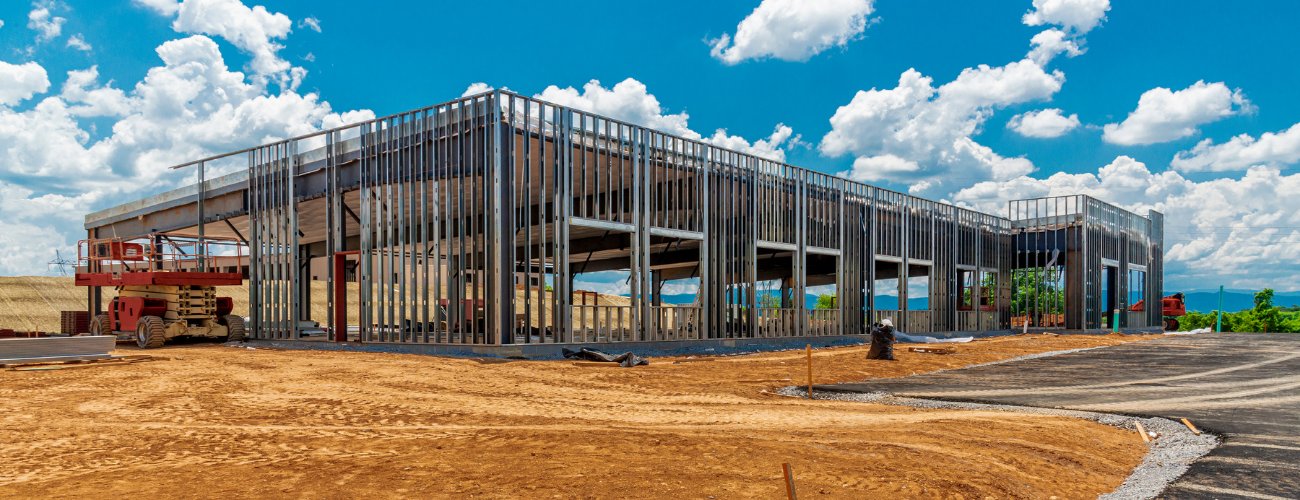
Oklahoma does not license general contractors at the state level, and the Construction Industries Board says so plainly on its own website. What the state does license is the trade work: electrical, mechanical, plumbing and roofing, along with building inspectors and home inspectors. For an owner hiring a builder for a commercial building, that gap leaves the vetting to you. We would rather you ask us the questions you would ask anyone: who holds the trade licenses on each scope, who carries the bonding and insurance, and who picks up the phone when a city inspector writes a correction.
Commercial construction, for us, means ground-up buildings and major renovations for private owners and public agencies in every part of the state, from a lease space in an Oklahoma City office park to a clinic pad in a town of a few thousand people. The work covers offices, shopping centers, restaurants, hotels, clinics, schools, municipal buildings and apartments, and each of those has its own page on this site. What follows is the general frame: how we organize a commercial job here, where the permit and code picture gets tricky, and where the money tends to move.
Three interstates, I-35, I-40 and I-44, meet in Oklahoma, which has more than 12,000 miles of highway, over 2,600 miles of Class I rail and two international airports at Oklahoma City and Tulsa, according to the state Department of Commerce. For a builder that network is the difference between a job that can take a truckload of steel on a Tuesday and a job that has to plan around a two-lane county road with a weight limit on the bridge.
We treat the state as a set of separate markets and price each one on its own terms. A metro project in Oklahoma City or Tulsa has deep subcontractor benches and a busy permit office. A project near Lawton or out in the northwest has fewer bidders per trade and longer hauls, and the budget has to say so up front rather than discover it in the third month.
The Oklahoma Uniform Building Code Commission sets statewide minimum building, fuel gas, mechanical, plumbing and residential codes. Cities then adopt and enforce their own codes and amendments, including Oklahoma City, Tulsa, Edmond and Norman, so each project follows the codes the local authority adopts and enforces. We read the building department's current notice at the start of every job instead of assuming one edition fits the whole state.
Because there is no state general contractor license, the practical checks are local: the permit office, the trade licenses on the electrical, plumbing and mechanical scopes, and the fire marshal. Our permitting and entitlements work starts with a pre-application conversation where the city allows one, because an early answer on setbacks, fire access or drainage is worth more than a perfect set of drawings that has to be reissued.
We begin with an estimate tied to the drawings and to the site, not to a square-foot average. On a project with a design team already in place we run preconstruction estimating against each design milestone, so the owner sees cost move while a change is still cheap. Where the owner wants one team accountable from the first sketch, we offer design-build delivery with the guaranteed price set once the scope is stable.
Once the building is released for construction, the order of work follows the utilities and the weather: site and underground first, then foundations and structure, then the envelope so interior trades can work dry. We hold a weekly look-ahead with every trade contractor and publish it, because the usual cause of a late commercial job is a trade arriving to find the work ahead of it unfinished.
The biggest swings are rarely the building itself. They are utility extensions, which can run long on a greenfield pad outside city limits, drainage and detention requirements, and the cost of getting people and equipment to a remote site. On a small-town project we also look hard at how many qualified bidders will actually be available for each trade, since a scope that draws two bids prices differently from one that draws six.
We keep contingency visible and assigned, and we ask owners to decide early on the items that change price the most: structural system, exterior finish, mechanical type and parking count. Those four decisions tend to account for more of the final number than any later change order.
Most owners come to us with a specific building in mind, and we route the work to the team that does it every week. An owner leasing space should start with tenant improvements; one reusing an older structure should look at renovation and adaptive reuse.
Developers assembling several parcels often begin with our work for commercial real estate developers, while agencies buying under public bid rules should read how we handle government and public-sector projects.
Whatever the starting point, the same people who estimate your job also run it, and that continuity is how we keep the schedule and scope promises made in the first meeting.
Tell us the site, the use and the date you need to open. We will answer with who would be on your job, how we would sequence it and where the risk sits, whether the building is in a metro or at the end of a county road. Reach out through the contact form and we will set up a working call.
FAQ
Send the property, the building type and the schedule. We review the scope, the approvals and the trade packages and explain how the project would be sequenced.